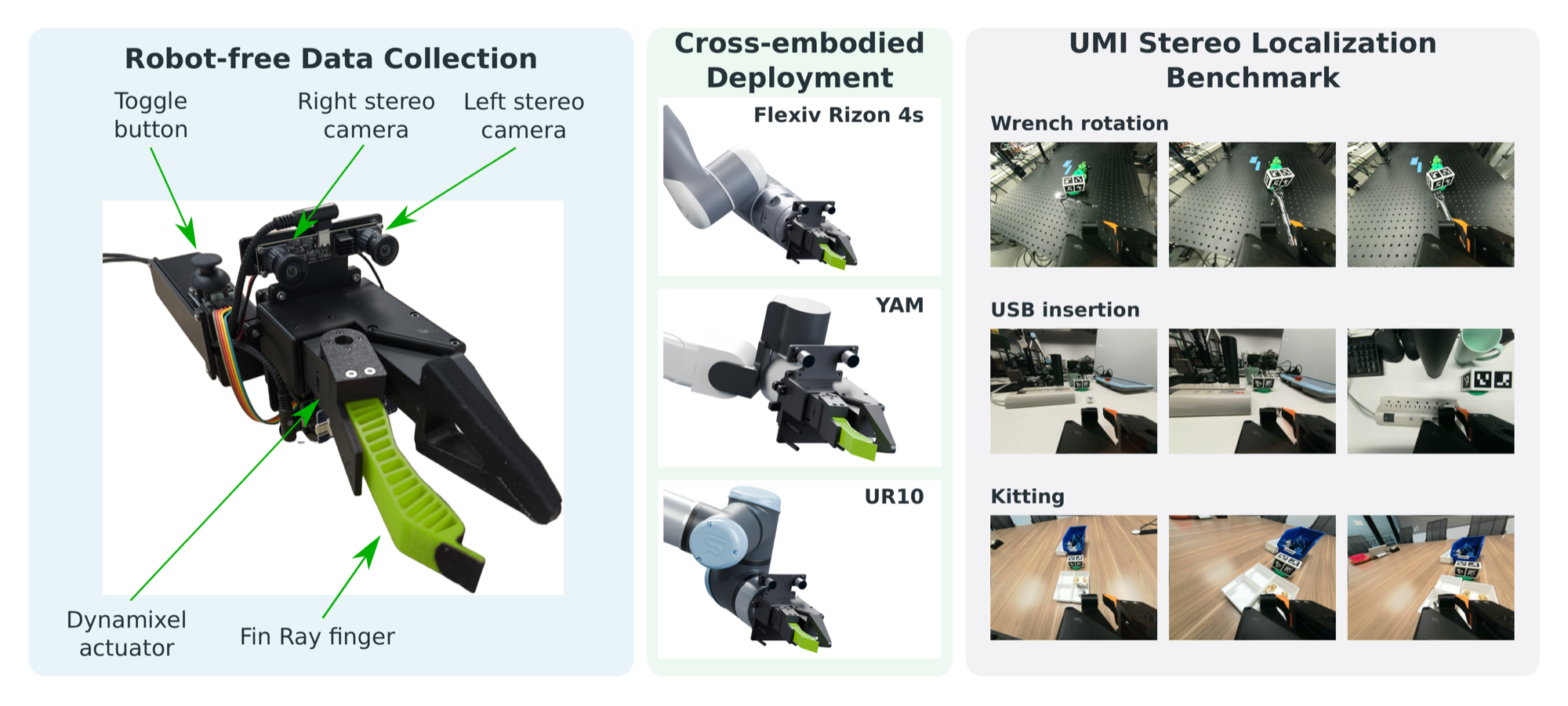
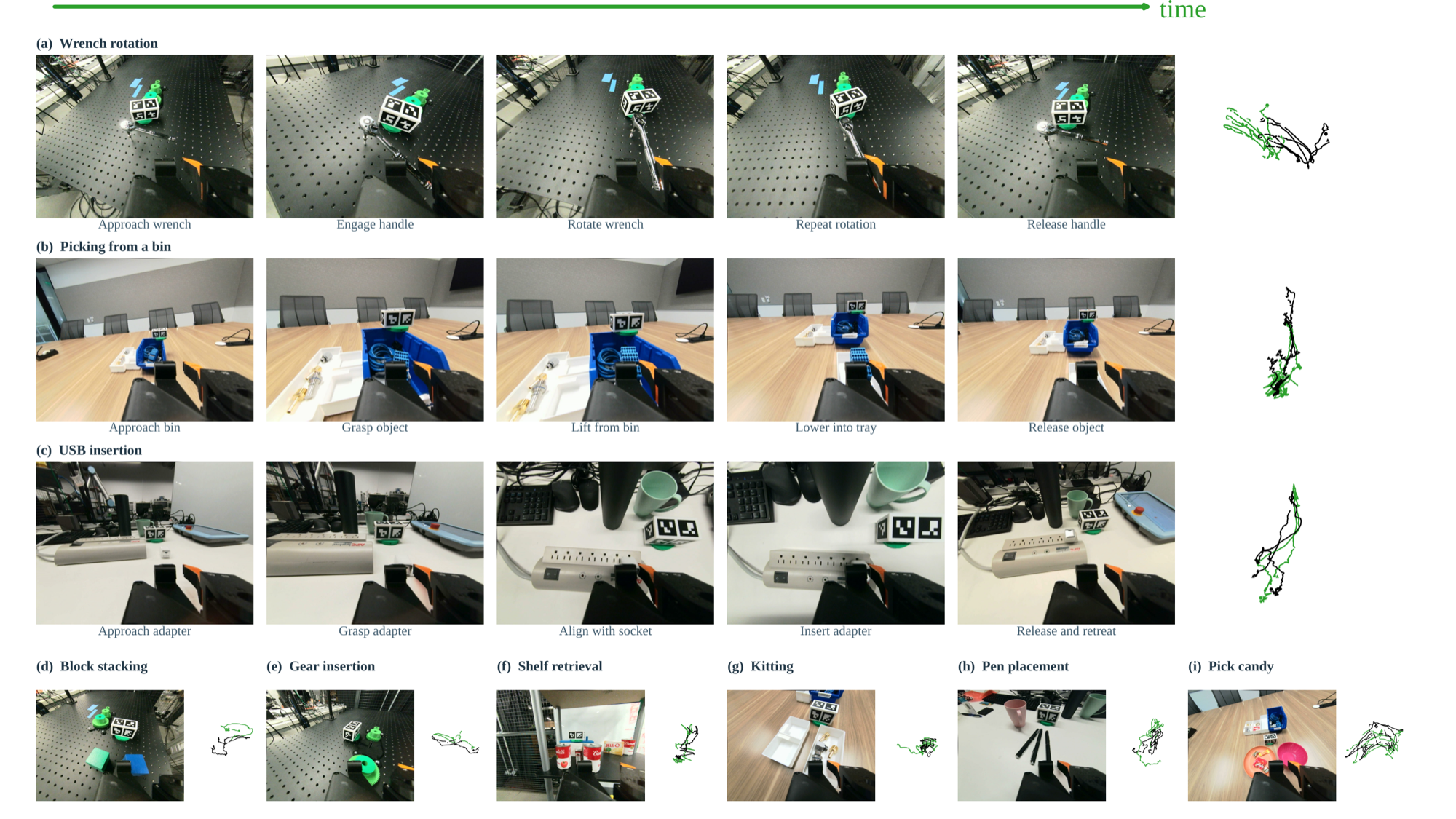
UMI-Loc-Bench-v1: nine manipulation tasks across tabletop and shelf environments.

OpenJaws system overview

Abstract

Handheld data-collection interfaces such as the Universal Manipulation Interface (UMI) allow manipulation demonstrations to be gathered in the wild without a robot in the loop, but the quality of the resulting action labels is bounded by the accuracy of vision-based localization. Existing systems recover end-effector pose from monocular visual-inertial odometry, which is subject to scale ambiguity and drift, or delegate tracking to closed-source modules and external infrastructure that reintroduce cost and setup burden. We present OpenJaws, a fully open hardware and software framework for sensorized UMI that improves localization and simplifies deployment across robot platforms. OpenJaws pairs a modular, 3D-printed gripper exposing a standardized ISO adapter with a low-cost stereo camera to recover metric camera trajectories. We further introduce UMI-Loc-Bench-v1, a benchmark quantifying real-world localization accuracy for handheld data-collection devices, and show that stereo localization substantially outperforms monocular alternatives. Finally, we demonstrate that policies trained on data collected with OpenJaws can be deployed on a real robot. Hardware, software, and data are released under a commercially permissive Apache 2.0 license.

~$400
Bill of Materials (BOM) cost to make a single gripper
2.9 mm
Stereo Localization translational error (ATE metric)
90 demos
UMI-Loc-Bench-v1, 9 tasks
UMI Real2Sim
Agentic Real-2-Sim digital twins in Isaac Lab

Video

Robot-Free Data Collection

Demonstrations are collected entirely without a robot in the loop. The operator holds the OpenJaws gripper, squeezes the toggle button to actuate the Dynamixel-driven jaw, and performs the task at natural speed; the wrist-mounted stereo pair records the whole session. Because the same gripper is later bolted onto the robot arm, there is no finger-mount redesign and no re-calibration of the camera-to-TCP transform between collection and deployment.

In-the-wild bin retrieval collected handheld with OpenJaws, next to the UR10 it will later be deployed on.

The OpenJaws Gripper

Open modules & Low-Cost

Off-the-shelf electronics only — Dynamixel XC430-W150-T actuator, Arduino OpenRB 150, MKR IMU shield, commodity stereo camera — with 3D printed parts and no custom PCB to fabricate.

Seamless integration

The ISO 9409-1-50-4-M6 flange mounts directly on most collaborative arms with no new adapter.

Stereo Localization

A global-shutter fisheye stereo camera, which — unlike a rolling shutter — does not skew images under fast handheld motion, preserving the correspondences localization depends on.

Stereo Localization

Localization builds on a stereo camera and classical triangulation, which determines the 3D position of a scene point by intersecting the rays projected through two calibrated camera centers. Triangulating corresponding pixels across two views separated by a known physical baseline resolves absolute scale — so, unlike a monocular camera, the rig recovers metric trajectories from vision alone, with no IMU and no external infrastructure.
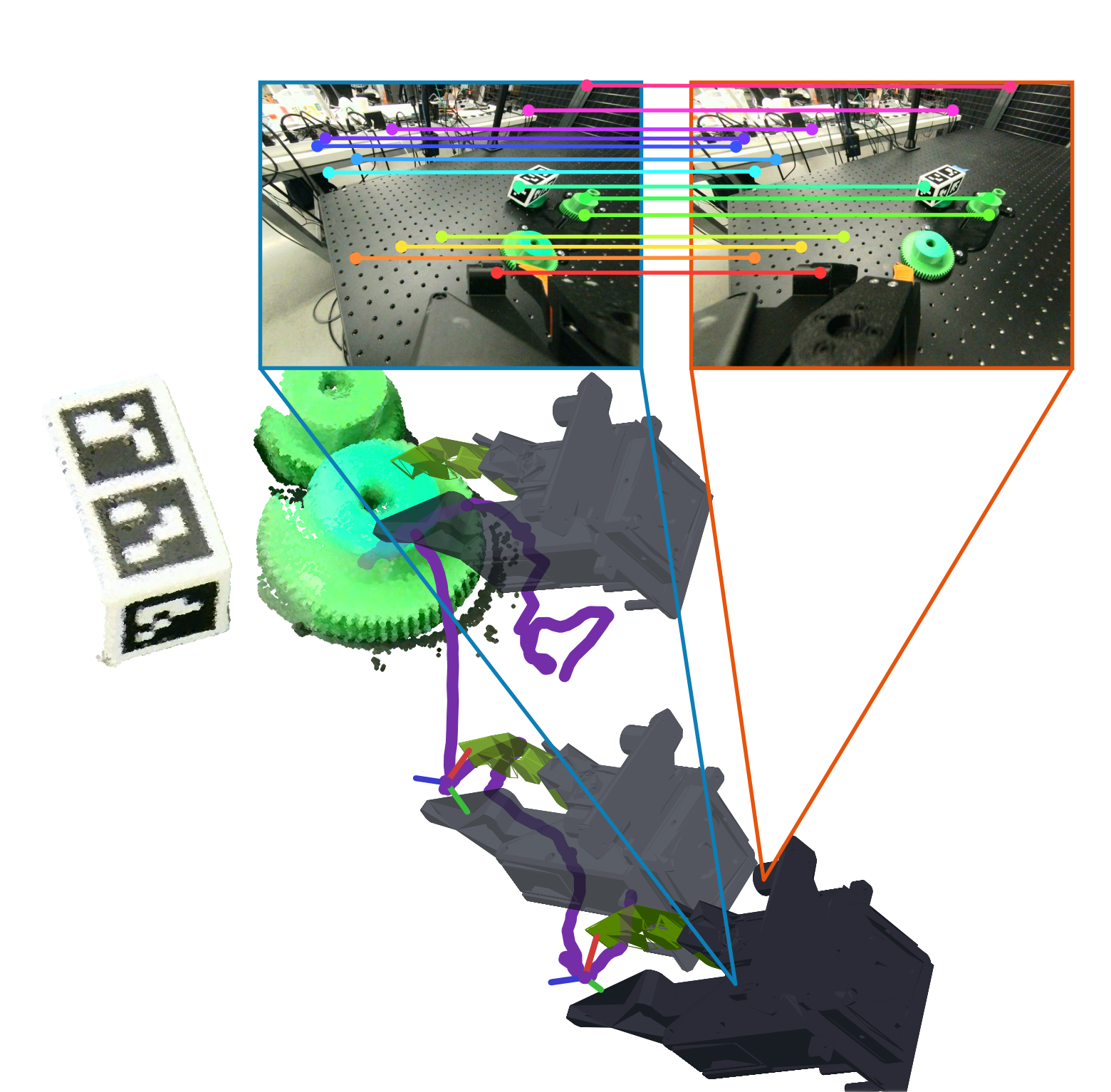
Handheld stereo data collection with OpenJaws

Handheld stereo data collection with OpenJaws. The purple curve is the recovered end-effector trajectory over the full recording. The insets are the rectified left (blue) and right (orange) frames captured at the starting pose, with SIFT correspondences drawn between them, and rays running from each lens to its image. The fiducial cube is used only for benchmarking, not for policy data collection; the point cloud, from FoundationStereo, is for visualization only.
UMI-Loc-Bench-v1

First SLAM/Localization benchmark for Robotic Manipulation Policy Learning

SLAM benchmarks exist for autonomous driving and indoor scene reconstruction, but to the best of our knowledge UMI-Loc-Bench-v1 is the first SLAM localization benchmark in the context of UMI or robotic manipulation for policy learning. It contains 90 handheld demonstrations — 10 for each of nine tasks — spanning short-horizon pick-and-place, constrained retrieval, contact-rich insertion, and non-prehensile manipulation, across multiple scenes. Ground truth comes from a static ArUco cube that is masked out of both camera streams before any method runs, and each method is scored on translational and rotational ATE after a scale-fixed Umeyama SE(3) alignment, plus wall-clock runtime.

UMI-Loc-Bench-v1 task sequences

Example rollouts from UMI-Loc-Bench-v1, with the recovered (green and black) end-effector trajectories for each task.

Localization Results

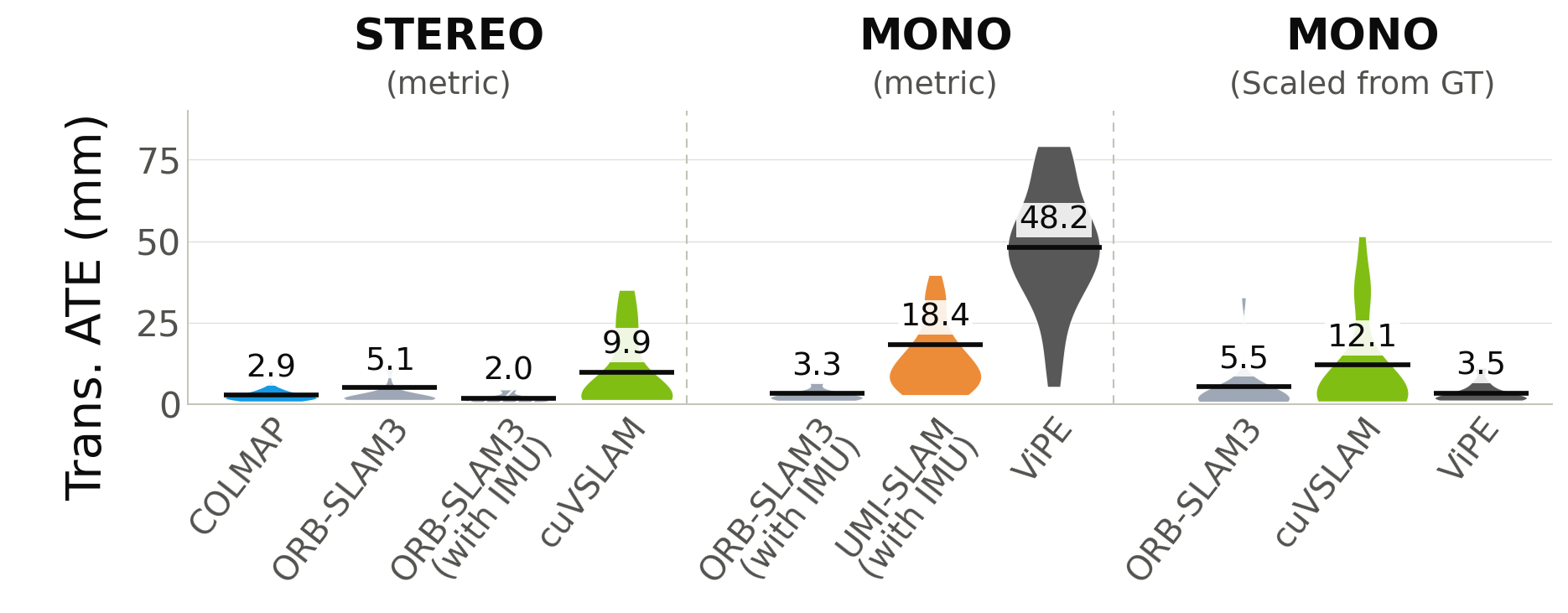
We evaluate representative SLAM and SfM backends spanning stereo, monocular, and monocular-inertial settings: COLMAP as a stereo-rig reconstruction, cuVSLAM (CUDA-accelerated SLAM meant for realtime applications), ORB-SLAM3 (the feature-based backend adopted by UMI), the learned monocular video-pose model ViPE, and UMI-SLAM — UMI's modified ORB-SLAM3 mono+IMU pipeline, which loads a prerecorded map and uses a known-size fiducial marker to stabilize initialization. Monocular baselines all use the left stereo image.

Translational ATE on UMI-Loc-Bench-v1

Translational ATE on the ground-truth segments tracked by UMI-SLAM, so every method is scored on identical segments. Black rules mark means; violins show the central 2–98%.

Main Takeaway

Stereo-based methods provide metric accurate trajectories with full coverage, and cuVSLAM (stereo) has the best accuracy–runtime tradeoff.

Coverage and Runtime

Stereo methods track essentially the full trajectory, whereas ORB-SLAM3 mono+IMU and UMI-SLAM average only 9% and 37% coverage. COLMAP is by far the slowest at 836 s per run against cuVSLAM's 34.8 s, so we use cuVSLAM for the policy-learning experiments.

Accuracy

COLMAP reaches 2.9 mm / 0.4° against 18.4 mm / 4.0° for UMI-SLAM, and among the pure-stereo backends it is the most accurate over full trajectories (5.2 mm / 0.8°, versus 7.4 mm for ORB-SLAM3 and 12.4 mm for cuVSLAM). The learned monocular model ViPE recovers geometrically faithful trajectories (3.5 mm / 0.7° with a fitted scale) but not metric ones — 48.2 mm at native scale. This is because a monocular camera cannot resolve absolute scale and the UMI-style wrist camera data we evaluated on is out-of-distribution for the room-scale data used for training ViPE.

Real Robot Deployment

Closed-loop diffusion-policy rollouts on two manipulation tasks (2X speedup)

UR10 rollouts: block stacking (left) and pick-and-place (right).

We train Diffusion Policy with a relative Cartesian end-effector action space on 200 demonstrations for block stacking and 50 for pick-and-place, localized with stereo-cuVSLAM. The gripper attaches directly onto the robot arm, requiring no recalibration between collection and deployment. Both policies reach a 90% success rate over 10 trials under varied initial conditions.

Real-to-Sim Deployment

Gear insertion shown in the real scene and its simulated reconstruction

Real scene, its digital twin in Isaac Lab, and the gripper motion overlay, played back side by side.

OpenJaws turns UMI demonstrations into simulation digital twins agentically: the GPT-6 (Astra) agent gets only the demonstration and sim-ready assets — not the objects' ground-truth poses — and recovers the scene graph itself. On the gear-insertion task it produces working twins for 7 of 10 demonstrations, automatically recovering the signed-distance-field collision geometry this contact-rich task needs.

Blending from Real to Sim

BibTeX

@article{openjaws2026,
  title         = {OpenJaws: An Open Hardware UMI Framework with Stereo Localization
                   for Generalist Manipulation},
  author        = {Murali, Adithyavairavan and Oza, Yash and Chahal, Karanbir and
                   Jawale, Neel and De Vries, Silas and Rabeti, Hesam and
                   Coumans, Erwin and Sundaralingam, Balakumar and Birchfield, Stan},
  journal       = {arXiv preprint arXiv:XXXX.XXXXX},
  year          = {2026},
}